Repository navigation
encoding/json/v2: new API for encoding/json #71497
Description

Proposal Details
This is a formal proposal for the addition of "encoding/json/v2" and "encoding/json/jsontext" packages that has previously been discussed in #63397. This proposal will be periodically updated to track changes to the proposed API based on community discussions and decisions by the json/v2 working group. See #71497 (comment) for a record of all changes over time.
This focuses on just the newly added API. An argument justifying the need for a v2 package can be found in prior discussion. Alternatively, you can watch the GopherCon talk entitled "The Future of JSON in Go".
Most of the API proposal below is copied from the discussion. If you've already read the discussion and only want to know what changed relative to the discussion, skip over to the "Changes from discussion" section.
This is the largest major revision of a standard Go package to date, so there will be many reasonable threads of further discussion. Before commenting, please check the list of sub-issues to see if your comment is better suited in a particular sub-issue. We'll be using sub-issues to isolate and focus discussion on particular topics.
Thank you to everyone who has been involved with the discussion, design review, code review, etc. This proposal is better off because of all your feedback.
This proposal was written with feedback from @mvdan, @johanbrandhorst, @rogpeppe, @ChrisHines, @neild, and @rsc.
Overview
In general, we propose the addition of the following:
- Package "encoding/json/jsontext", which handles processing of JSON purely at a syntactic layer (with no dependencies on Go reflection). This is a lower-level package that most users will not use, but still sufficiently useful to expose as a standalone package.
- Package "encoding/json/v2", which will serve as the second major version of the v1 "encoding/json" package. It is implemented in terms of "jsontext".
- Options in v1 "encoding/json" to provide inter-operability with v2. The v1 package will be implemented entirely in terms of "json/v2".
JSON serialization can be broken down into two primary components:
- syntactic functionality that is concerned with processing JSON based on its grammar, and
- semantic functionality that determines the meaning of JSON values as Go values and vice-versa.
We use the terms "encode" and "decode" to describe syntactic functionality and the terms "marshal" and "unmarshal" to describe semantic functionality.
We aim to provide a clear distinction between functionality that is purely concerned with encoding versus that of marshaling. For example, it should be possible to encode a stream of JSON tokens without needing to marshal a concrete Go value representing them. Similarly, it should be possible to decode a stream of JSON tokens without needing to unmarshal them into a concrete Go value.
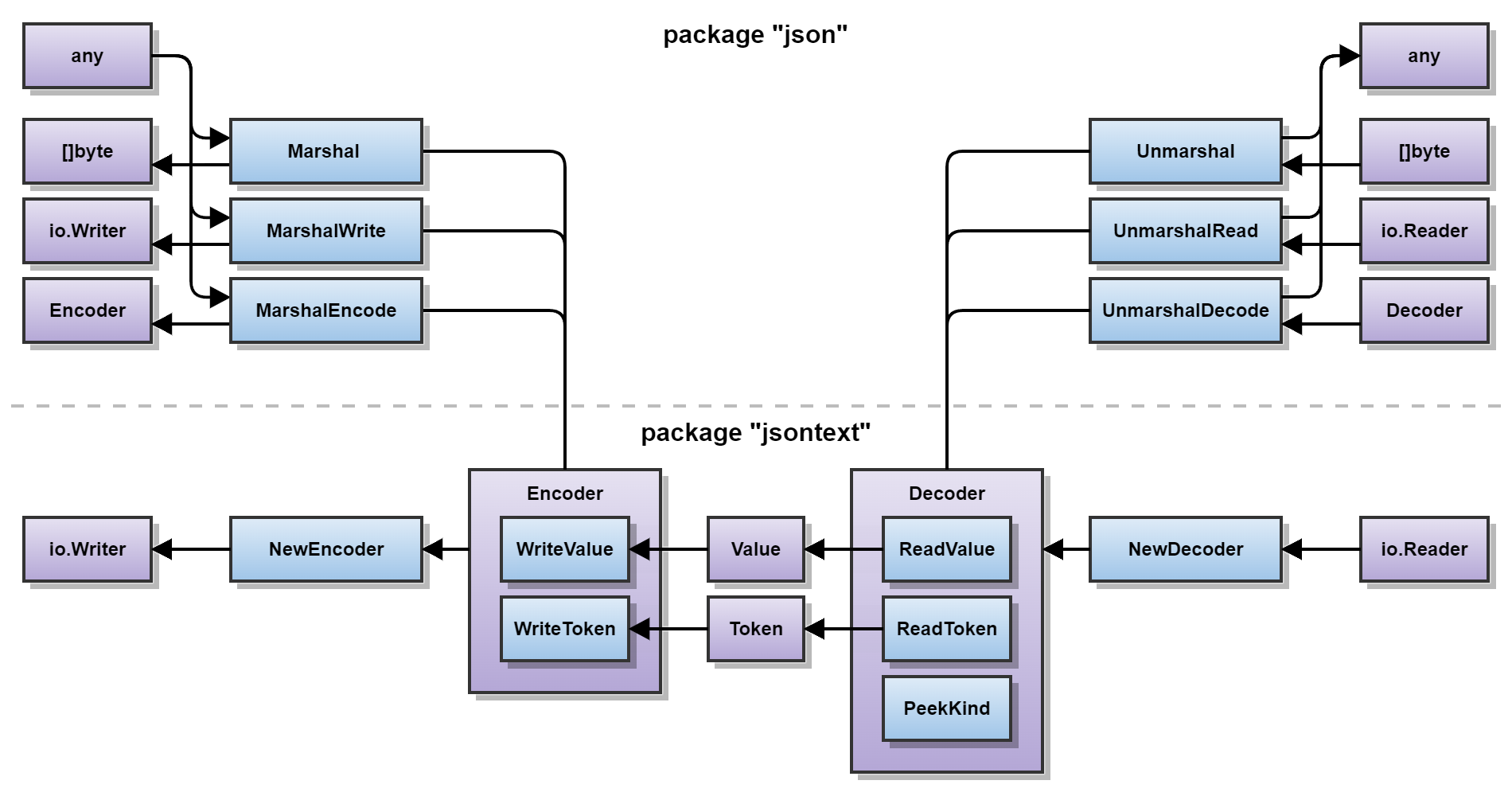
This diagram provides a high-level overview of the v2 API. Purple blocks represent types, while blue blocks represent functions or methods. The direction of the arrows represent the approximate flow of data. The bottom half (as implemented by the "jsontext" package) of the diagram contains functionality that is only concerned with syntax, while the upper half (as implemented by the "json" package) contains functionality that assigns semantic meaning to syntactic data handled by the bottom half.
Package "encoding/json/jsontext"
The jsontext package provides functionality to process JSON purely according to the grammar.
Overview
The basic API consists of the following:
package jsontext // "encoding/json/jsontext"

type Encoder struct { /* no exported fields */ }
func NewEncoder(io.Writer, ...Options) *Encoder
func (*Encoder) WriteToken(Token) error
func (*Encoder) WriteValue(Value) error

type Decoder struct { /* no exported fields */ }
func NewDecoder(io.Reader, ...Options) *Decoder
func (*Decoder) PeekKind() Kind
func (*Decoder) ReadToken() (Token, error)
func (*Decoder) ReadValue() (Value, error)
func (*Decoder) SkipValue() error

type Kind byte
type Token struct { /* no exported fields */ }
func (Token) Kind() Kind
type Value []byte
func (Value) Kind() Kind
Tokens and Values
The primary data types for interacting with JSON are Kind, Token, and Value.
The Kind is an enumeration that describes the kind of a token or value.
// Kind represents each possible JSON token kind with a single byte,
// which is the first byte of that kind's grammar.
type Kind byte
func (k Kind) String() string

const (
	KindInvalid     Kind = 0   // invalid kind
	KindNull        Kind = 'n' // null
	KindFalse       Kind = 'f' // false
	KindTrue        Kind = 't' // true
	KindString      Kind = '"' // string
	KindNumber      Kind = '0' // number
	KindBeginObject Kind = '{' // begin object
	KindEndObject   Kind = '}' // end object
	KindBeginArray  Kind = '[' // begin array
	KindEndArray    Kind = ']' // end array
)
A Token represents a lexical JSON token, which cannot represent entire array or object values. It is analogous to the v1 Token type, but is designed to be allocation-free by being an opaque struct type.
type Token struct { /* no exported fields */ }

var (
	Null  Token = rawToken("null")
	False Token = rawToken("false")
	True  Token = rawToken("true")

	BeginObject Token = rawToken("{")
	EndObject   Token = rawToken("}")
	BeginArray  Token = rawToken("[")
	EndArray    Token = rawToken("]")
)

func Bool(b bool) Token
func Int(n int64) Token
func Uint(n uint64) Token
func Float(n float64) Token
func Float32(n float32) Token
func String(s string) Token
func (t Token) Clone() Token
func (t Token) Bool() bool
func (t Token) Int() (int64, error)
func (t Token) Uint() (uint64, error)
func (t Token) Float() (float64, error)
func (t Token) Float32() (float32, error)
func (t Token) String() string
func (t Token) Kind() Kind
Note that the Int, Uint, and Float methods report an error since a JSON number may not correspond cleanly to a Go int64, uint64, or float64. Even when an error is reported, the closest representable value is still returned.
The Float32 construct and accessor provide explicit support for 32-bit precision floating-point numbers, while most of the JSON ecosystem usually assume that floating-point numbers are formatted with 64-bit precision.
A Value is the raw representation of a single JSON value. Unlike Token, they can also represent entire array or object values. It is analogous to the v1 RawMessage type.
type Value []byte

func (v Value) Clone() Value
func (v Value) String() string
func (v Value) IsValid(opts ...Options) bool
func (v *Value) Format(opts ...Options) error
func (v *Value) Compact(opts ...Options) error
func (v *Value) Indent(opts ...Options) error
func (v *Value) Canonicalize(opts ...Options) error
func (v Value) MarshalJSON() ([]byte, error)
func (v *Value) UnmarshalJSON(b []byte) error
func (v Value) Kind() Kind // never ']' or '}' if valid
By default, IsValid validates according to RFC 7493, but accepts options to validate according to looser guarantees (such as allowing duplicate names or invalid UTF-8).
The Format method formats the value according to the specified encoder options.
The Compact and Indent methods operate similar to the v1 Compact and Indent functions.
The Canonicalize method canonicalizes the JSON value according to the JSON Canonicalization Scheme as defined in RFC 8785.
The Compact, Indent, and Canonicalize each call Format with a default list of options. The caller may provide additional options to override the defaults.
Formatting
Some top-level functions are provided for formatting JSON values and strings.
// AppendFormat formats the JSON value in src and appends it to dst
// according to the specified options.
// See [Value.Format] for more details about the formatting behavior.
func AppendFormat[Bytes ~[]byte | ~string](dst []byte, src Bytes, opts ...Options) ([]byte, error)

// AppendQuote appends a double-quoted JSON string literal representing src
// to dst and returns the extended buffer.
func AppendQuote[Bytes ~[]byte | ~string](dst []byte, src Bytes) ([]byte, error)

// AppendUnquote appends the decoded interpretation of src as a
// double-quoted JSON string literal to dst and returns the extended buffer.
// The input src must be a JSON string without any surrounding whitespace.
func AppendUnquote[Bytes ~[]byte | ~string](dst []byte, src Bytes) ([]byte, error)

// AppendFloat appends src to dst as a JSON number per RFC 8259, section 6.
//
// Except for -0, which is formatted as -0 instead of 0,
// the output is identical to ECMA-262, 10th edition, section 7.1.12.1
// and (for 64-bit precision) identical to RFC 8785, section 3.2.2.3.
// The values NaN, +Inf, and -Inf will be represented as a JSON string
// with the values "NaN", "Infinity", and "-Infinity".
func AppendFloat(dst []byte, src float64, bits int) []byte
Encoder and Decoder
The Encoder and Decoder types provide the functionality for encoding to or decoding from an io.Writer or an io.Reader. An Encoder or Decoder can be constructed with NewEncoder or NewDecoder using default options.
The Encoder is a streaming encoder from raw JSON tokens and values. It is used to write a stream of top-level JSON values, each terminated with a newline character.
type Encoder struct { /* no exported fields */ }

func NewEncoder(w io.Writer, opts ...Options) *Encoder
func (e *Encoder) Reset(w io.Writer, opts ...Options)

// WriteToken writes the next token and advances the internal write offset.
// The provided token must be consistent with the JSON grammar.
func (e *Encoder) WriteToken(t Token) error

// WriteValue writes the next raw value and advances the internal write offset.
// The provided value must be consistent with the JSON grammar.
func (e *Encoder) WriteValue(v Value) error

// AvailableBuffer returns a zero-length buffer with a possible non-zero capacity.
// This buffer is intended to be used to populate a Value
// being passed to an immediately succeeding WriteValue call.
//
// Example usage:
//
//	b := d.AvailableBuffer()
//	b = append(b, '"')
//	b = appendString(b, v) // append the string formatting of v
//	b = append(b, '"')
//	... := d.WriteValue(b)
func (e *Encoder) AvailableBuffer() []byte

// OutputOffset returns the current output byte offset, which is the location
// of the next byte immediately after the most recently written token or value.
func (e *Encoder) OutputOffset() int64
The Decoder is a streaming decoder for raw JSON tokens and values. It is used to read a stream of top-level JSON values, each separated by optional whitespace characters.
type Decoder struct { /* no exported fields */ }

func NewDecoder(r io.Reader, opts ...Options) *Decoder
func (d *Decoder) Reset(r io.Reader, opts ...Options)

// PeekKind returns the kind of the token that would be returned by ReadToken.
// It does not advance the read offset.
func (d *Decoder) PeekKind() Kind

// ReadToken reads the next Token, advancing the read offset.
// The returned token is only valid until the next Peek, Read, or Skip call.
// It returns io.EOF if there are no more tokens.
func (d *Decoder) ReadToken() (Token, error)

// ReadValue returns the next raw JSON value, advancing the read offset.
// The returned value is only valid until the next Peek, Read, or Skip call
// and may not be mutated while the Decoder remains in use.
// It returns io.EOF if there are no more values.
func (d *Decoder) ReadValue() (Value, error)

// SkipValue is equivalent to calling ReadValue and discarding the result except
// that memory is not wasted trying to hold the entire value.
func (d *Decoder) SkipValue() error

// UnreadBuffer returns the data remaining in the unread buffer.
// The returned buffer must not be mutated while Decoder continues to be used.
// The buffer contents are valid until the next Peek, Read, or Skip call.
func (d *Decoder) UnreadBuffer() []byte

// InputOffset returns the current input byte offset, which is the location
// of the next byte immediately after the most recently returned token or value.
func (d *Decoder) InputOffset() int64
Some methods common to both Encoder and Decoder report information about the current state.
// Options returns the options used to construct the encoder or decoder and
// may additionally contain options passed to a
// [encoding/json/v2.MarshalEncode] or
// [encoding/json/v2.UnmarshalDecode] call.
func (e *Encoder) Options() Options
func (d *Decoder) Options() Options

// StackDepth returns the depth of the state machine.
// Each level on the stack represents a nested JSON object or array.
// It is incremented whenever an BeginObject or BeginArray token is encountered
// and decremented whenever an EndObject or EndArray token is encountered.
// The depth is zero-indexed, where zero represents the top-level JSON value.
func (e *Encoder) StackDepth() int
func (d *Decoder) StackDepth() int

// StackIndex returns information about the specified stack level.
// It must be a number between 0 and StackDepth, inclusive.
// For each level, it reports the kind:
//
//   - 0 for a level of zero,
//   - '{' for a level representing a JSON object, and
//   - '[' for a level representing a JSON array.
//
// It also reports the length so far of that JSON object or array.
// Each name and value in a JSON object is counted separately,
// so the effective number of members would be half the length.
// A complete JSON object must have an even length.
func (e *Encoder) StackIndex(i int) (Kind, int64)
func (d *Decoder) StackIndex(i int) (Kind, int64)

// StackPointer returns a JSON Pointer (RFC 6901) to the most recently handled value.
func (e *Encoder) StackPointer() Pointer
func (d *Decoder) StackPointer() Pointer
Options
The behavior of Encoder and Decoder may be altered by passing options to NewEncoder and NewDecoder, which take in a variadic list of options.
type Options = jsonopts.Options

// AllowDuplicateNames specifies that JSON objects may contain
// duplicate member names.
func AllowDuplicateNames(v bool) Options // affects encode and decode

// AllowInvalidUTF8 specifies that JSON strings may contain invalid UTF-8,
// which will be mangled as the Unicode replacement character, U+FFFD.
func AllowInvalidUTF8(v bool) Options // affects encode and decode

// CanonicalizeRawFloats specifies that when encoding a raw JSON floating-point number
// (i.e., a number with a fraction or exponent) in a [Token] or [Value],
// the number is canonicalized according to RFC 8785, section 3.2.2.3.
func CanonicalizeRawFloats(v bool) Options // affects encode only

// CanonicalizeRawInts specifies that when encoding a raw JSON integer number
// (i.e., a number without a fraction and exponent) in a [Token] or [Value],
// the number is canonicalized according to RFC 8785, section 3.2.2.3.
func CanonicalizeRawInts(v bool) Options // affects encode only

// PreserveRawStrings specifies that when encoding a raw JSON string
// in a [Token] or [Value], pre-escaped sequences in a JSON string
// are preserved to the output.
func PreserveRawStrings(v bool) Options // affects encode only

// ReorderRawObjects specifies that when encoding a raw JSON object in a [Value],
// the object members are reordered according to RFC 8785, section 3.2.3.
func ReorderRawObjects(v bool) Options // affects encode only

// EscapeForHTML specifies that '<', '>', and '&' characters within JSON strings
// should be escaped as a hexadecimal Unicode codepoint (e.g., \u003c)
// so that the output is safe to embed within HTML.
func EscapeForHTML(v bool) Options // affects encode only

// EscapeForJS specifies that U+2028 and U+2029 characters within JSON strings
// should be escaped as a hexadecimal Unicode codepoint (e.g., \u2028)
// so that the output is valid to embed within JavaScript.
// See RFC 8259, section 12.
func EscapeForJS(v bool) Options // affects encode only

// Multiline specifies that the JSON output should be expanded, where
// every JSON object member or JSON array element appears on a new, indented line
// according to the nesting depth.
// If an indent is not already specified, then it defaults to using "\t".
func Multiline(v bool) Options // affects encode only

// WithIndent specifies that the encoder should emit multiline output
// where each element in a JSON object or array begins on a new, indented line
// beginning with the indent prefix (see WithIndentPrefix) followed by
// one or more copies of indent according to the nesting depth.
func WithIndent(indent string) Options // affects encode only

// WithIndentPrefix specifies that the encoder should emit multiline output
// where each element in a JSON object or array begins on a new, indented line
// beginning with the indent prefix followed by
// one or more copies of indent (see WithIndent) according to the nesting depth.
func WithIndentPrefix(prefix string) Options // affects encode only

// SpaceAfterColon specifies that the JSON output should emit a space character
// after each colon separator following a JSON object name.
func SpaceAfterColon(v bool) Options // affects encode only

// SpaceAfterComma specifies that the JSON output should emit a space character
// after each comma separator following a JSON object value or array element.
func SpaceAfterComma(v bool) Options // affects encode only
The Options type is a type alias to an internal type that is an interface type with no exported methods. It is used simply as a marker type for options declared in the "json" and "jsontext" packages.
Latter options specified in the variadic list passed to NewEncoder and NewDecoder take precedence over prior option values. For example, NewEncoder(AllowInvalidUTF8(false), AllowInvalidUTF8(true)) results in AllowInvalidUTF8(true) taking precedence.
Options that do not affect the operation in question are ignored. For example, passing Multiline to NewDecoder does nothing.
The WithIndent and WithIndentPrefix flags configure the appearance of whitespace in the output. Their semantics are identical to the v1 Encoder.SetIndent method.
Errors
Errors due to non-compliance with the JSON grammar are reported as a SyntacticError.
type SyntacticError struct {
	// ByteOffset indicates that an error occurred after this byte offset.
	ByteOffset int64
	// JSONPointer indicates that an error occurred within this JSON value
	// as indicated using the JSON Pointer notation (see RFC 6901).
	JSONPointer Pointer
	// Err is the underlying error.
	Err error // always non-nil
}
func (e *SyntacticError) Error() string
func (e *SyntacticError) Unwrap() error
Errors due to I/O are returned as an opaque error that unwrap to the original error returned by the failing io.Reader.Read or io.Writer.Write call.
// ErrDuplicateName indicates that a JSON token could not be
// encoded or decoded because it results in a duplicate JSON object name.
var ErrDuplicateName = errors.New("duplicate object member name")

// ErrNonStringName indicates that a JSON token could not be
// encoded or decoded because it is not a string,
// as required for JSON object names according to RFC 8259, section 4.
var ErrNonStringName = errors.New("object member name must be a string")
ErrDuplicateName and ErrNonStringName are sentinel errors that are
returned while being wrapped within a SyntacticError.
// Pointer is a JSON Pointer (RFC 6901) that references a particular JSON value
// relative to the root of the top-level JSON value.
//
// A Pointer is a slash-separated list of tokens, where each token is
// either a JSON object name or an index to a JSON array element
// encoded as a base-10 integer value.
type Pointer string

// IsValid reports whether p is a valid JSON Pointer according to RFC 6901.
func (p Pointer) IsValid() bool

// AppendToken appends a token to the end of p and returns the full pointer.
func (p Pointer) AppendToken(tok string) Pointer

// Parent strips off the last token and returns the remaining pointer.
func (p Pointer) Parent() Pointer

// Contains reports whether the JSON value that p points to
// is equal to or contains the JSON value that pc points to.
func (p Pointer) Contains(pc Pointer) bool

// LastToken returns the last token in the pointer.
func (p Pointer) LastToken() string

// Tokens returns an iterator over the reference tokens in the JSON pointer.
func (p Pointer) Tokens() iter.Seq[string]
Pointer is a named type representing a JSON Pointer (RFC 6901) and references a particular JSON value relative to a top-level JSON value. It is primarily used for error reporting, but its utility could be expanded in the future (e.g. extracting or modifying a portion of a Value by Pointer reference alone).
Package "encoding/json/v2"
The v2 "json" package provides functionality to marshal or unmarshal JSON data from or into Go value types. This package depends on "jsontext" to process JSON text and the "reflect" package to dynamically introspect Go values at runtime.
Most users will interact directly with the "json" package without ever needing to interact with the lower-level "jsontext package.
Overview
The basic API consists of the following:
package json // "encoding/json/v2"

func Marshal(in any, opts ...Options) (out []byte, err error)
func MarshalWrite(out io.Writer, in any, opts ...Options) error
func MarshalEncode(out *jsontext.Encoder, in any, opts ...Options) error

func Unmarshal(in []byte, out any, opts ...Options) error
func UnmarshalRead(in io.Reader, out any, opts ...Options) error
func UnmarshalDecode(in *jsontext.Decoder, out any, opts ...Options) error
The Marshal and Unmarshal functions mostly match the signature of the same functions in v1, however their behavior differs.
The MarshalWrite and UnmarshalRead functions are analogous functionality that operate on an io.Writer and io.Reader instead of []byte. The UnmarshalRead function consumes the entire input until io.EOF and reports an error if any invalid tokens appear after the end of the JSON value (#36225).
The MarshalEncode and UnmarshalDecode functions are analogous functionality that operate on an *jsontext.Encoder and *jsontext.Decoder instead of []byte. Unlike UnmarshalRead, UnmarshalDecode does not read until io.EOF, allowing successive calls to process each JSON value as a stream.
All marshal and unmarshal functions accept a variadic list of options that configure the behavior of serialization.
Default behavior
The marshal and unmarshal logic in v2 is mostly identical to v1 with following changes:
-
In v1, JSON object members are unmarshaled into a Go struct using a case-insensitive name match with the JSON name of the fields. In contrast, v2 matches fields using an exact, case-sensitive match. The
MatchCaseInsensitiveNamesandjsonv1.MatchCaseSensitiveDelimiteroptions control this behavior difference. To explicitly specify a Go struct field to use a particular name matching scheme, either thecase:ignoreor thecase:strictfield option can be specified. Field-specified options take precedence over caller-specified options. -
In v1, when marshaling a Go struct, a field marked as
omitemptyis omitted if the field value is an "empty" Go value, which is defined as false, 0, a nil pointer, a nil interface value, and any empty array, slice, map, or string. In contrast, v2 redefinesomitemptyto omit a field if it encodes as an "empty" JSON value, which is defined as a JSON null, or an empty JSON string, object, or array. Thejsonv1.OmitEmptyWithLegacySemanticsoption controls this behavior difference. Note thatomitemptybehaves identically in both v1 and v2 for a Go array, slice, map, or string (assuming no user-definedMarshalJSONmethod overrides the default representation). Existing usages ofomitemptyon a Go bool, number, pointer, or interface value should migrate to specifyingomitzeroinstead (which is identically supported in both v1 and v2). See prior discussion for more information. -
In v1, a nil Go slice or Go map is marshaled as a JSON null. In contrast, v2 marshals a nil Go slice or Go map as an empty JSON array or JSON object, respectively. The
FormatNilSliceAsNullandFormatNilMapAsNulloptions control this behavior difference. See prior discussion for more information. -
In v1, a Go array may be unmarshaled from a JSON array of any length. In contrast, in v2 a Go array must be unmarshaled from a JSON array of the same length, otherwise it results in an error. The
jsonv1.UnmarshalArrayFromAnyLengthoption controls this behavior difference. -
In v1, a Go byte array (i.e.,
~[N]byte) is represented as a JSON array of JSON numbers. In contrast, in v2 a Go byte array is represented as a Base64-encoded JSON string. Thejsonv1.FormatByteArrayAsArrayoption controls this behavior difference. -
In v1,
MarshalJSONmethods declared on a pointer receiver are only called if the Go value is addressable. In contrast, in v2 aMarshalJSONmethod is always callable regardless of addressability. Thejsonv1.CallMethodsWithLegacySemanticsoption controls this behavior difference. -
In v1,
MarshalJSONandUnmarshalJSONmethods are never called for Go map keys. In contrast, in v2 aMarshalJSONorUnmarshalJSONmethod is eligible for being called for Go map keys. Thejsonv1.CallMethodsWithLegacySemanticsoption controls this behavior difference. -
In v1, a Go map is marshaled in a deterministic order. In contrast, in v2 a Go map is marshaled in a non-deterministic order. The
Deterministicoption controls this behavior difference. See prior discussion for more information. -
In v1, JSON strings are encoded with HTML-specific or JavaScript-specific characters being escaped. In contrast, in v2 JSON strings use the minimal encoding and only escape if required by the JSON grammar. The
jsontext.EscapeForHTMLandjsontext.EscapeForJSoptions control this behavior difference. -
In v1, bytes of invalid UTF-8 within a string are silently replaced with the Unicode replacement character. In contrast, in v2 the presence of invalid UTF-8 results in an error. The
jsontext.AllowInvalidUTF8option controls this behavior difference. -
In v1, a JSON object with duplicate names is permitted. In contrast, in v2 a JSON object with duplicate names results in an error. The
jsontext.AllowDuplicateNamesoption controls this behavior difference. -
In v1, when unmarshaling a JSON null into a non-empty Go value it will inconsistently either zero out the value or do nothing. In contrast, in v2 unmarshaling a JSON null will consistently and always zero out the underlying Go value. The
jsonv1.MergeWithLegacySemanticsoption controls this behavior difference. -
In v1, when unmarshaling a JSON value into a non-zero Go value, it merges into the original Go value for array elements, slice elements, struct fields (but not map values), pointer values, and interface values (only if a non-nil pointer). In contrast, in v2 unmarshal merges into the Go value for struct fields, map values, pointer values, and interface values. In general, the v2 semantic merges when unmarshaling a JSON object, otherwise it replaces the value. The
jsonv1.MergeWithLegacySemanticsoption controls this behavior difference. -
In v1, a
time.Durationis represented as a JSON number containing the decimal number of nanoseconds. In contrast, in v2 atime.Durationhas no default representation and reports a runtime error when trying JSON serialize it. Thejsonv1.FormatDurationAsNanooption controls this behavior difference. -
In v1, errors are never reported at runtime for Go struct types that have some form of structural error (e.g., a malformed tag option). In contrast, v2 reports a runtime error for Go types that are invalid as they relate to JSON serialization. For example, a Go struct with only unexported fields cannot be serialized. The
jsonv1.ReportErrorsWithLegacySemanticsoption controls this behavior difference.
While the behavior of Marshal and Unmarshal in "json/v2" is changing relative to v1 "json", note that the behavior of v1 "json" remains as is.
Struct tag options
Similar to v1, v2 also supports customized representation of Go struct fields through the use of struct tags. As before, the json tag will be used. The following tag options are supported:
-
omitzero: When marshaling, the "omitzero" option specifies that the struct field should be omitted if the field value is zero, as determined by the "IsZero() bool" method, if present, otherwise based on whether the field is the zero Go value (per
reflect.Value.IsZero). This option has no effect when unmarshaling. (example)- New in v2, but has already been backported to v1 (see encoding/json: add omitzero option #45669) in Go 1.24.
-
omitempty: When marshaling, the "omitempty" option specifies that the struct field should be omitted if the field value would have been encoded as a JSON null, empty string, empty object, or empty array. This option has no effect when unmarshaling. (example)
- Changed in v2. In v1, the "omitempty" option was narrowly defined as only omitting a field if it is a Go false, 0, a nil pointer, a nil interface value, and any empty array, slice, map, or string. In v2, it has been redefined in terms of the JSON type system, rather than the Go type system. They are practically equivalent except for Go bools, numbers, pointers, and interfaces for which the "omitzero" option can be used instead.
-
string: The "string" option specifies that the nominal JSON value by quoted within a JSON string when marshaling or unmarshaling a struct field value. This causes numeric types to be encoded as a JSON number within a JSON string, and to be decoded from a JSON string containing a JSON number. This extra level of encoding is often necessary since many JSON parsers cannot precisely represent 64-bit integers.
- Changed in v2. In v1, the "string" option applied to certain types where use of a JSON string did not make sense (e.g., a bool or string). In v2, this feature only applies to numeric types and reports a runtime error when applied otherwise.
-
case:ignore: When unmarshaling, the "case:ignore" option specifies that if the JSON object name does not exactly match the JSON name for any of the struct fields, then it attempts to match the struct field using a case-insensitive match that also ignores dashes and underscores. (example)
- New in v2. Since v2 no longer performs a case-insensitive match of JSON object names, this option provides a means to opt-into the v1-like behavior. However, the case-insensitive match is altered relative to v1 in that it also ignores dashes and underscores. This makes the feature more broadly useful for JSON objects with different naming conventions to be unmarshaled. For example, "fooBar", "FOO_BAR", or "foo-bar" will all match with a field named "FooBar".
-
case:strict: When unmarshaling, the "case:strict" option specifies that the JSON object name must exactly match the JSON name for the struct field. This takes precedence even if MatchCaseInsensitiveNames is set to true. This cannot be specified together with the "case:ignore" option.
- New in v2 to provide an explicit author-specified way to prevent
MatchCaseInsensitiveNamesfrom taking effect on a particular field. This option provides a means to opt-into the v2-like behavior.
- New in v2 to provide an explicit author-specified way to prevent
-
inline: The "inline" option specifies that the JSON object representation of this field is to be promoted as if it were specified in the parent struct. It is the JSON equivalent of Go struct embedding. A Go embedded field is implicitly inlined unless an explicit JSON name is specified. The inlined field must be a Go struct that does not implement
MarshalerorUnmarshaler. Inlined fields of typejsontext.Valueandmap[~string]Tare called “inlined fallbacks”, as they can represent all possible JSON object members not directly handled by the parent struct. Only one inlined fallback field may be specified in a struct, while many non-fallback fields may be specified. This option must not be specified with any other tag option. (example)- New in v2. Inlining is an explicit way to embed a JSON object within another JSON object without relying on Go struct embedding. The feature is capable of inlining Go maps and
jsontext.Value(#6213).
- New in v2. Inlining is an explicit way to embed a JSON object within another JSON object without relying on Go struct embedding. The feature is capable of inlining Go maps and
The "omitzero" and "omitempty" options are similar. The former is defined in terms of the Go type system, while the latter in terms of the JSON type system. Consequently they behave differently in some circumstances. For example, only a nil slice or map is omitted under "omitzero", while an empty slice or map is omitted under "omitempty" regardless of nilness. The "omitzero" option is useful for types with a well-defined zero value (e.g., netip.Addr) or have an IsZero method (e.g., time.Time).
Note that all tag options labeled with "Changed in v2" will behave as it has always historically behaved when using v1 "json". However, all tag options labeled with "New in v2" will be implicitly and retroactively supported in v1 "json" because v1 will be implemented under-the-hood using "json/v2".
Type-specified customization
Go types may customize their own JSON representation by implementing certain interfaces that the "json" package knows to look for:
type Marshaler interface {
	MarshalJSON() ([]byte, error)
}
type MarshalerTo interface {
	MarshalJSONTo(*jsontext.Encoder) error
}

type Unmarshaler interface {
	UnmarshalJSON([]byte) error
}
type UnmarshalerFrom interface {
	UnmarshalJSONFrom(*jsontext.Decoder) error
}
The v1 Marshaler and Unmarshaler interfaces are supported in v2 to provide greater degrees of backward compatibility.
The MarshalerTo and UnmarshalerFrom interfaces operate in a purely streaming manner and provide a means for plumbing down options. This API can provide dramatic performance improvements (see "Performance").
If a type implements both sets of marshaling or unmarshaling interfaces, then the streaming variant takes precedence.
Just like v1, encoding.TextMarshaler and encoding.TextUnmarshaler interfaces remain supported in v2, where these interfaces are treated with lower precedence than JSON-specific serialization interfaces.
Caller-specified customization
In addition to Go types being able to specify their own JSON representation, the caller of the marshal or unmarshal functionality can also specify their own JSON representation for specific Go types (#5901). Caller-specified customization takes precedence over type-specified customization.
// Marshalers holds a list of functions that may override the marshal behavior
// of specific types. Populate WithMarshalers to use it.
// A nil *Marshalers is equivalent to an empty list.
type Marshalers struct { /* no exported fields */ }

// JoinMarshalers constructs a flattened list of marshal functions.
// If multiple functions in the list are applicable for a value of a given type,
// then those earlier in the list take precedence over those that come later.
// If a function returns [errors.ErrUnsupported], then the next applicable function is called,
// otherwise the default marshaling behavior is used.
//
// For example:
//
//	m1 := JoinMarshalers(f1, f2)
//	m2 := JoinMarshalers(f0, m1, f3)     // equivalent to m3
//	m3 := JoinMarshalers(f0, f1, f2, f3) // equivalent to m2
func JoinMarshalers(ms ...*Marshalers) *Marshalers

// MarshalFunc constructs a type-specific marshaler that
// specifies how to marshal values of type T.
func MarshalFunc[T any](fn func(T) ([]byte, error)) *Marshalers

// MarshalToFunc constructs a type-specific marshaler that
// specifies how to marshal values of type T.
// The function is always provided with a non-nil pointer value
// if T is an interface or pointer type.
func MarshalToFunc[T any](fn func(*jsontext.Encoder, T) error) *Marshalers

// Unmarshalers holds a list of functions that may override the unmarshal behavior
// of specific types. Populate WithUnmarshalers to use it.
// A nil *Unmarshalers is equivalent to an empty list.
type Unmarshalers struct { /* no exported fields */ }

// JoinUnmarshalers constructs a flattened list of unmarshal functions.
// It operates in a similar manner as [JoinMarshalers].
func JoinUnmarshalers(us ...*Unmarshalers) *Unmarshalers

// UnmarshalFunc constructs a type-specific unmarshaler that
// specifies how to unmarshal values of type T.
func UnmarshalFunc[T any](fn func([]byte, T) error) *Unmarshalers

// UnmarshalFromFunc constructs a type-specific unmarshaler that
// specifies how to unmarshal values of type T.
// T must be an unnamed pointer or an interface type.
// The function is always provided with a non-nil pointer value.
func UnmarshalFromFunc[T any](fn func(*jsontext.Decoder, T) error) *Unmarshalers
Caller-specified customization is a powerful feature. For example:
- It can be used to marshal Go errors (example).
- It can be used to preserve the raw representation of JSON numbers (example). Note that v2 does not have the v1
RawNumbertype. - It can be used to preserve the input offset of JSON values for error reporting purposes (example).
Options
Options may be specified that configure how marshal and unmarshal operates:
// Options configure Marshal, MarshalWrite, MarshalEncode,
// Unmarshal, UnmarshalRead, and UnmarshalDecode with specific features.
// Each function takes in a variadic list of options, where properties set
// in latter options override the value of previously set properties.
//
// Options represent either a singular option or a set of options.
// It can be functionally thought of as a Go map of option properties
// (even though the underlying implementation avoids Go maps for performance).
//
// The constructors (e.g., Deterministic) return a singular option value:
//	opt := Deterministic(true)
// which is analogous to creating a single entry map:
//	opt := Options{"Deterministic": true}
//
// JoinOptions composes multiple options values to together:
//	out := JoinOptions(opts...)
// which is analogous to making a new map and copying the options over:
//	out := make(Options)
//	for _, m := range opts {
//		for k, v := range m {
//			out[k] = v
//		}
//	}
//
// GetOption looks up the value of options parameter:
//	v, ok := GetOption(opts, Deterministic)
// which is analogous to a Go map lookup:
//	v, ok := opts["Deterministic"]
//
// There is a single Options type, which is used with both marshal and unmarshal.
// Options that do not affect a particular operation are ignored.
type Options = jsonopts.Options

// DefaultOptionsV2 is the full set of all options that define v2 semantics.
// It is equivalent to all options under [Options], [encoding/json.Options],
// and [encoding/json/jsontext.Options] being set to false or the zero value,
// except for the options related to whitespace formatting.
func DefaultOptionsV2() Options

// Deterministic specifies that the same input value will be serialized
// as the exact same output bytes. Different processes of
// the same program will serialize equal values to the same bytes,
// but different versions of the same program are not guaranteed
// to produce the exact same sequence of bytes.
func Deterministic(v bool) Options // affects marshal only

// FormatNilMapAsNull specifies that a nil Go map should marshal as a
// JSON null instead of the default representation as an empty JSON object.
func FormatNilMapAsNull(v bool) Options // affects marshal only

// FormatNilSliceAsNull specifies that a nil Go slice should marshal as a
// JSON null instead of the default representation as an empty JSON array
// (or an empty JSON string in the case of ~[]byte).
func FormatNilSliceAsNull(v bool) Options // affects marshal only

// MatchCaseInsensitiveNames specifies that JSON object members are matched
// against Go struct fields using a case-insensitive match of the name.
func MatchCaseInsensitiveNames(v bool) Options // affects marshal and unmarshal

// RejectUnknownMembers specifies that unknown members should be rejected
// when unmarshaling a JSON object, regardless of whether there is a field
// to store unknown members.
func RejectUnknownMembers(v bool) Options // affects unmarshal only

// OmitZeroStructFields specifies that a Go struct should marshal in such a way
// that all struct fields that are zero are omitted from the marshaled output
// if the value is zero as determined by the "IsZero() bool" method if present,
// otherwise based on whether the field is the zero Go value.
func OmitZeroStructFields(v bool) Options // affects marshal only

// WithMarshalers specifies a list of type-specific marshalers to use,
// which can be used to override the default marshal behavior
// for values of particular types.
func WithMarshalers(v *Marshalers) Options // affects marshal only

// WithUnmarshalers specifies a list of type-specific unmarshalers to use,
// which can be used to override the default unmarshal behavior
// for values of particular types.
func WithUnmarshalers(v *Unmarshalers) Options // affects unmarshal only

// JoinOptions coalesces the provided list of options into a single Options.
// Properties set in latter options override the value of previously set properties.
func JoinOptions(srcs ...Options) Options

// GetOption returns the value stored in opts with the provided constructor,
// reporting whether the value is present.
func GetOption[T any](opts Options, constructor func(T) Options) (T, bool)
The Options type is a type alias to an internal type that is an interface type with no exported methods. It is used simply as a marker type for options declared in the "json" and "jsontext" package. This is exactly the same Options type as the one in the "jsontext" package.
The same Options type is used for both Marshal and Unmarshal as some options affect both operations.
The MarshalJSONTo, UnmarshalJSONFrom, MarshalToFunc, and UnmarshalFromFunc methods and functions take in a jsontext.Encoder or jsontext.Decoder, which has an Options method to obtain the set of options specified.
Errors
Errors due to the inability to correlate JSON data with Go data are reported as SemanticError.
type SemanticError struct {
	// ByteOffset indicates that an error occurred after this byte offset.
	ByteOffset int64
	// JSONPointer indicates that an error occurred within this JSON value
	// as indicated using the JSON Pointer notation (see RFC 6901).
	JSONPointer jsontext.Pointer

	// JSONKind is the JSON kind that could not be handled.
	JSONKind Kind // may be zero if unknown
	// JSONValue is the JSON number or string that could not be unmarshaled.
	JSONValue jsontext.Value // may be nil if irrelevant or unknown
	// GoType is the Go type that could not be handled.
	GoType reflect.Type // may be nil if unknown

	// Err is the underlying error.
	Err error // may be nil
}
func (e *SemanticError) Error() string
func (e *SemanticError) Unwrap() error
// ErrUnknownName indicates that a JSON object member could not be
// unmarshaled because the name is not known to the target Go struct.
// This error is directly wrapped within a [SemanticError] when produced.
var ErrUnknownName = errors.New("unknown object member name")ErrUnknownName is a sentinel error that is returned while being wrapped within a SemanticError.
Package "encoding/json"
The API and behavior for v1 "json" remains unchanged except for the addition of new options to configure v2 to operate with legacy v1 behavior.
Options
Options may be specified that configures v2 "json" to operate with legacy v1 behavior:
type Options = jsonopts.Options

// DefaultOptionsV1 is the full set of all options that define v1 semantics.
// It is equivalent to the following boolean options being set to true:
//
//   - [CallMethodsWithLegacySemantics]
//   - [FormatByteArrayAsArray]
//   - [FormatBytesWithLegacySemantics]
//   - [FormatDurationAsNano]
//   - [MatchCaseSensitiveDelimiter]
//   - [MergeWithLegacySemantics]
//   - [OmitEmptyWithLegacySemantics]
//   - [ParseBytesWithLooseRFC4648]
//   - [ParseTimeWithLooseRFC3339]
//   - [ReportErrorsWithLegacySemantics]
//   - [StringifyWithLegacySemantics]
//   - [UnmarshalArrayFromAnyLength]
//   - [jsonv2.Deterministic]
//   - [jsonv2.FormatNilMapAsNull]
//   - [jsonv2.FormatNilSliceAsNull]
//   - [jsonv2.MatchCaseInsensitiveNames]
//   - [jsontext.AllowDuplicateNames]
//   - [jsontext.AllowInvalidUTF8]
//   - [jsontext.EscapeForHTML]
//   - [jsontext.EscapeForJS]
//   - [jsontext.PreserveRawString]
//
// The [Marshal] and [Unmarshal] functions in this package are
// semantically identical to calling the v2 equivalents with this option:
//
//	jsonv2.Marshal(v, jsonv1.DefaultOptionsV1())
//	jsonv2.Unmarshal(b, v, jsonv1.DefaultOptionsV1())
func DefaultOptionsV1() Options

// CallMethodsWithLegacySemantics specifies that calling of type-provided
// marshal and unmarshal methods follow legacy semantics:
//
//   - When marshaling, a marshal method declared on a pointer receiver
//     is only called if the Go value is addressable.
//     Values obtained from an interface or map element are not addressable.
//     Values obtained from a pointer or slice element are addressable.
//     Values obtained from an array element or struct field inherit
//     the addressability of the parent. In contrast, the v2 semantic
//     is to always call marshal methods regardless of addressability.
//
//   - When marshaling or unmarshaling, the [Marshaler] or [Unmarshaler]
//     methods are ignored for map keys. However, [encoding.TextMarshaler]
//     or [encoding.TextUnmarshaler] are still callable.
//     In contrast, the v2 semantic is to serialize map keys
//     like any other value (with regard to calling methods),
//     which may include calling [Marshaler] or [Unmarshaler] methods,
//     where it is the implementation's responsibility to represent the
//     Go value as a JSON string (as required for JSON object names).
//
//   - When marshaling, if a map key value implements a marshal method
//     and is a nil pointer, then it is serialized as an empty JSON string.
//     In contrast, the v2 semantic is to report an error.
//
//   - When marshaling, if an interface type implements a marshal method
//     and the interface value is a nil pointer to a concrete type,
//     then the marshal method is always called.
//     In contrast, the v2 semantic is to never directly call methods
//     on interface values and to instead defer evaluation based upon
//     the underlying concrete value. Similar to non-interface values,
//     marshal methods are not called on nil pointers and
//     are instead serialized as a JSON null.
func CallMethodsWithLegacySemantics(bool) Options // affects marshal and unmarshal

// FormatByteArrayAsArray specifies that a Go [N]byte is
// formatted as as a normal Go array in contrast to the v2 default of
// formatting [N]byte as using binary data encoding (RFC 4648).
//
// This affects either marshaling or unmarshaling.
func FormatByteArrayAsArray(v bool) Options // affects marshal and unmarshal

// FormatBytesWithLegacySemantics specifies that handling of
// []~byte and [N]~byte types follow legacy semantics:
//
//   - A Go []~byte is to be treated as using some form of
//     binary data encoding (RFC 4648) in contrast to the v2 default
//     of only treating []byte as such. In particular, v2 does not
//     treat slices of named byte types as representing binary data.
//
//   - When marshaling, if a named byte implements a marshal method,
//     then the slice is serialized as a JSON array of elements,
//     each of which call the marshal method.
//
//   - When unmarshaling, if the input is a JSON array,
//     then unmarshal into the []~byte as if it were a normal Go slice.
//     In contrast, the v2 default is to report an error unmarshaling
//     a JSON array when expecting some form of binary data encoding.
func FormatBytesWithLegacySemantics(bool) Options // affects marshal and unmarshal

// FormatDurationAsNano specifies that a [time.Duration] is
// formatted as a JSON number representing the number of nanoseconds
// in contrast to the v2 default of reporting an error.
func FormatDurationAsNano(v bool) Options // affects marshal and unmarshal

// MatchCaseSensitiveDelimiter specifies that underscores and dashes are
// not to be ignored when performing case-insensitive name matching which
// occurs under [jsonv2.MatchCaseInsensitiveNames] or the `case:ignore` tag option.
// Thus, case-insensitive name matching is identical to [strings.EqualFold].
// Use of this option diminishes the ability of case-insensitive matching
// to be able to match common case variants (e.g, "foo_bar" with "fooBar").
func MatchCaseSensitiveDelimiter(bool) Options // affects marshal and unmarshal

// MergeWithLegacySemantics specifies that unmarshaling into a non-zero
// Go value follows legacy semantics:
//
//   - When unmarshaling a JSON null, this preserves the original Go value
//     if the kind is a bool, int, uint, float, string, array, or struct.
//     Otherwise, it zeros the Go value.
//     In contrast, the default v2 behavior is to consistently and always
//     zero the Go value when unmarshaling a JSON null into it.
//
//   - When unmarshaling a JSON value other than null, this merges into
//     the original Go value for array elements, slice elements,
//     struct fields (but not map values),
//     pointer values, and interface values (only if a non-nil pointer).
//     In contrast, the default v2 behavior is to merge into the Go value
//     for struct fields, map values, pointer values, and interface values.
//     In general, the v2 semantic merges when unmarshaling a JSON object,
//     otherwise it replaces the original value.
func MergeWithLegacySemantics(bool) Options // affects unmarshal only

// OmitEmptyWithLegacySemantics specifies that the `omitempty` tag option
// follows a definition of empty where a field is omitted if the Go value is
// false, 0, a nil pointer, a nil interface value,
// or any empty array, slice, map, or string.
// This overrides the v2 semantic where a field is empty if the value
// marshals as a JSON null or an empty JSON string, object, or array.
//
// The v1 and v2 definitions of `omitempty` are practically the same for
// Go strings, slices, arrays, and maps. Usages of `omitempty` on
// Go bools, ints, uints floats, pointers, and interfaces should migrate to use
// the `omitzero` tag option, which omits a field if it is the zero Go value.
func OmitEmptyWithLegacySemantics(bool) Options // affects marshal only


// ParseBytesWithLooseRFC4648 specifies that when parsing
// binary data encoded as "base32" or "base64",
// to ignore the presence of '\r' and '\n' characters.
// In contrast, the v2 default is to report an error in order to be
// strictly compliant with RFC 4648, section 3.3,
// which specifies that non-alphabet characters must be rejected.
func ParseBytesWithLooseRFC4648(v bool) Options // affect unmarshal only

// ParseTimeWithLooseRFC3339 specifies that a [time.Time]
// parses according to loose adherence to RFC 3339.
// In particular, it permits historically incorrect representations,
// allowing for deviations in hour format, sub-second separator,
// and timezone representation. In contrast, the default v2 behavior
// is to strictly comply with the grammar specified in RFC 3339.
func ParseTimeWithLooseRFC3339(v bool) Options // affects unmarshal only

// ReportErrorsWithLegacySemantics specifies that Marshal and Unmarshal
// should report errors with legacy semantics:
//
//   - When marshaling or unmarshaling, the returned error values are
//     usually of types such as [SyntaxError], [MarshalerError],
//     [UnsupportedTypeError], [UnsupportedValueError],
//     [InvalidUnmarshalError], or [UnmarshalTypeError].
//     In contrast, the v2 semantic is to always return errors as either
//     [jsonv2.SemanticError] or [jsontext.SyntacticError].
//
//   - When marshaling, if a user-defined marshal method reports an error,
//     it is always wrapped in a [MarshalerError], even if the error itself
//     is already a [MarshalerError], which may lead to multiple redundant
//     layers of wrapping. In contrast, the v2 semantic is to
//     always wrap an error within [jsonv2.SemanticError]
//     unless it is already a semantic error.
//
//   - When unmarshaling, if a user-defined unmarshal method reports an error,
//     it is never wrapped and reported verbatim. In contrast, the v2 semantic
//     is to always wrap an error within [jsonv2.SemanticError]
//     unless it is already a semantic error.
//
//   - When marshaling or unmarshaling, if a Go struct contains type errors
//     (e.g., conflicting names or malformed field tags), then such errors
//     are ignored and the Go struct uses a best-effort representation.
//     In contrast, the v2 semantic is to report a runtime error.
//
//   - When unmarshaling, the syntactic structure of the JSON input
//     is fully validated before performing the semantic unmarshaling
//     of the JSON data into the Go value. Practically speaking,
//     this means that JSON input with syntactic errors do not result
//     in any mutations of the target Go value. In contrast, the v2 semantic
//     is to perform a streaming decode and gradually unmarshal the JSON input
//     into the target Go value, which means that the Go value may be
//     partially mutated when a syntactic error is encountered.
//
//   - When unmarshaling, a semantic error does not immediately terminate the
//     unmarshal procedure, but rather evaluation continues.
//     When unmarshal returns, only the first semantic error is reported.
//     In contrast, the v2 semantic is to terminate unmarshal the moment
//     an error is encountered.
func ReportErrorsWithLegacySemantics(bool) Options // affects marshal and unmarshal

// StringifyWithLegacySemantics specifies that the `string` tag option
// may stringify bools and string values. It only takes effect on fields
// where the top-level type is a bool, string, numeric kind, or a pointer to
// such a kind. Specifically, `string` will not stringify bool, string,
// or numeric kinds within a composite data type
// (e.g., array, slice, struct, map, or interface).
//
// When marshaling, such Go values are serialized as their usual
// JSON representation, but quoted within a JSON string.
// When unmarshaling, such Go values must be deserialized from
// a JSON string containing their usual JSON representation.
// A JSON null quoted in a JSON string is a valid substitute for JSON null
// while unmarshaling into a Go value that `string` takes effect on.
func StringifyWithLegacySemantics(bool) Options // affects marshal only

// UnmarshalArrayFromAnyLength specifies that Go arrays can be unmarshaled
// from input JSON arrays of any length. If the JSON array is too short,
// then the remaining Go array elements are zeroed. If the JSON array
// is too long, then the excess JSON array elements are skipped over.
func UnmarshalArrayFromAnyLength(bool) Options // affects unmarshal only
Many of the options configure fairly obscure behavior. Unfortunately, many of the behaviors cannot be changed in order to maintain backwards compatibility. This is a major justification for a v2 "json" package.
Let jsonv1 be v1 "encoding/json" and jsonv2 be "encoding/json/v2", then the v1 and v2 options can be composed together to obtain behavior that is identical to v1, identical to v2, or anywhere in between. For example:
jsonv1.Marshal(v)- uses default v1 semantics
jsonv2.Marshal(in, jsonv1.DefaultOptionsV1())- semantically equivalent to
jsonv1.Marshal
- semantically equivalent to
jsonv2.Marshal(in, jsonv1.DefaultOptionsV1(), jsontext.AllowDuplicateNames(false))- uses mostly v1 semantics, but opts into one v2-specific behavior
jsonv2.Marshal(in, jsonv1.StringifyWithLegacySemantics(true), jsonv1.ReportErrorsWithLegacySemantics(true))- uses mostly v2 semantics, but opts into two v1-specific behaviors
jsonv2.Marshal(v, ..., jsonv2.DefaultOptionsV2())- semantically equivalent to
jsonv2.Marshalsincejsonv2.DefaultOptionsV2overrides any options specified earlier in the...
- semantically equivalent to
jsonv2.Marshal(v)- uses default v2 semantics
Types aliases
The following types are moved to v2 "json":
type Marshaler = jsonv2.Marshaler
type Unmarshaler = jsonv2.Unmarshaler
type RawMessage = jsontext.Value
Number methods
The Number type no longer has special-case support in the "json" implementation itself.
func (Number) MarshalJSONTo(*jsontext.Encoder) error
func (*Number) UnmarshalJSONFrom(*jsontext.Decoder) error
So methods are added to have it implement the v2 MarshalerTo and UnmarshalerFrom methods to preserve equivalent behavior.
Errors
The UnmarshalTypeError type is extended to wrap an underlying error:
type UnmarshalTypeError struct {
	...
	Err error
}

func (*UnmarshalTypeError) Unwrap() error
Errors returned by v2 "json" are much richer, so the wrapped error provides a way for v1 "json" to preserve some of that context, while still using the UnmarshalTypeError type, which many programs may still be expecting.
The UnmarshalTypeError.Field now reports a dot-delimited path to the error value where each path segment is either a JSON array and map index operation. This is a divergence from prior behavior which was always inconsistent about whether the position was reported according to the Go namespace or the JSON namespace (see #43126).
Activity
dsnet commentedon Jan 31, 2025
Changes from discussion
If you have already read the discussion in #63397, then much of the API presented above may be familiar. This section records the differences made relative to the discussion.
Package "encoding/json/jsontext"
The following
Valuemethods were altered to accept options.Accepting options allows the default behavior of these methods to be overridden, providing greater flexibility in usage.
The removal of the
prefixandindentargument fromIndentimproves the ergonomics of the method as most users just want indented output without thinking about the particularindentstring used. These can still be specified using theWithIndentPrefixandWithIndentoptions.One major criticism of
Canonicalize(per RFC 8785) is that it mangles the precision of wide integers. By accepting options, users can additionally specifyCanonicalizeRawInts(false)to prevent this behavior, while still having canonicalization for all other JSON artifacts.The
Formatmethod was newly added as the primary implementation backingCompact,Indent, andCanonicalize.The following options were added to provide greater flexibility to formatting:
The
Expandoption was renamed asMultilineto be more clear and to distinguish it fromSpaceAfterCommaandSpaceAfterColon(which both technically "expand" the output).The following formatting API has been added:
The length returned by
StackIndexis now aint64instead ofintsince the length of a JSON array or object could theoretically exceedintwhen handling JSON in a purely streaming manner. The stack depth, however, remains fundamentally limited by the amount of system memory, so anintis still an appropriate type.The pointer returned by
StackPointeris now the namedPointertype.An explicit
Pointertype was added to represent a JSON Pointer (RFC 6901) as a means to identify exactly where an error occurred. Convenience methods are defined for interacting with a pointer.Handling of errors was improved:
  type SyntacticError struct {
  	...
- 	JSONPointer string
+ 	JSONPointer Pointer
  }

+ var ErrDuplicateName = errors.New("duplicate object member name")
+ var ErrNonStringName = errors.New("object member name must be a string")
The
ErrDuplicateNameandErrNonStringNameerrors were added to support common error conditions users may want to distinguish upon through the use oferrors.Is.Package "encoding/json/v2"
Interface types and methods were renamed to avoid the
V1andV2suffixes, which were aesthetically unpleasant. Instead, theV2declarations now generally use theToandFromsuffixes to indicate that they support streaming. This follows after the convention established byio.WriterToandio.ReaderFrom.The constructor for
MarshalersandUnmarshalerswere renamed using theJoinprefix to be more consistent with the existingJoinOptionsconstructor. It also more clearly matches exactly what the constructor does.The following options were added:
+ func OmitZeroStructFields(v bool) OptionsThe
OmitZeroStructFieldsis a caller-specified option that mirrors the addition of theomitzerostruct tag option.type SemanticError struct { ... - JSONPointer string + JSONPointer jsontext.Pointer + JSONValue jsontext.Value } + var ErrUnknownName = errors.New("unknown object member name")The
ErrUnknownNameerror was added to support common use-cases wanting to distinguish this particular condition (see #29035).The following behavior changes were made to marshal and unmarshal:
There is newly added support for the
strictcaseoption to provide a better migration path between users of both v1 and v2.Specifying the
stringtag option now rejects unmarshaling from a JSON number and only permits unmarshaling from a JSON string. This exactly matches the behavior of v1.When unmarshaling, a floating-point overflow results in an error. This exactly matches the behavior of v1.
Serialization now supports embedded fields of unexported struct types with exported fields. This exactly matches the behavior of v1.
Package "encoding/json"
Some options for legacy v1 support were renamed or had similar options folded together.
In general, many options were renamed with a
WithLegacySemanticssuffix because they convered a multitude of behavior differences that could not be adequently described with a concise name.The
RejectFloatOverflowoption was removed because v2 now rejects floating-point overflows just like v1.The
EscapeInvalidUTF8option was added in order to support a behavior difference that was discovered while implementing v1 support in terms of v2. We may avoid adding this as it controls fairly esoteric and undocumented behavior.The
Numbertype implementsMarshalerToandUnmarshalerFromfor better compatibility with v2.The
UnmarshalTypeErrortype now supports error wrapping.type UnmarshalTypeError struct { ... + Err error } + func (*UnmarshalTypeError) Unwrap() errorChanges not made from discussion
There were many ideas discussed in #63397 that did not result in changes to the current proposal. Some ideas are still worth pursuing, while others were declined for various reasons. In general, ideas that could later be built on top of the initial release of v2 were deferred so that we could focus on the current API. We prioritized ideas that could not be explored after the initial API was finalized.
The following is a non-exhaustive list of such considerations:
Option structs instead of variadic options: An older prototype of the v2 implementation used option structs, but was refactored to use variadic options once work began implementing v1 in terms of v2. In general, options operate upon several dimensions: v1 versus v2, marshal versus unmarshal, and encode versus decode. Some options are valid in multiple dimensions (e.g., marshal and unmarshal). Some call sites accept options from multiple dimensions (e.g., marshal and encode). A singular options type is more ergonomic, but loses type safety. We deem the wins of the former stronger than the losses of the latter.
User-defined option values:
json.Optionsshould support user-provided values. One possible future proposal could be aWithOption[T any](v T)constructor to convert a user-provided value into an option. See #71664 for a separate proposal.User-defined format values:
json.Optionsshould support specifying format values (e.g., that alltime.Timetypes use the "unix" format). One possible future proposal could be aWithFormat[T any](s string)constructor to declare arbitrary formats for custom use. See #71664 for a separate proposal.context.Contextplumbing:json.MarshalerToandjson.UnmarshalerFromcould accept acontext.Context. A context serves two purposes: 1) cancelation of an operation, 2) plumbing of user-defined options. Cancelation does not make sense in "json" since theio.Readerandio.Writerinterfaces provide no direct way to cancel a read or write operation. Plumbing of options should be done by extending the existingjson.Optionstype to support user-defined options (see above ideas). Thus, there is little utility to plumbing acontext.Context.Treat
[]byteas just strings:~[]byteand~[N]bytetypes should support aformat:stringoption that treats such types as if they were Go strings. This can be a future proposal.Use ISO 8601 for
time.Duration: While JavaScript in TC39 recently defined a grammar for durations based on a particular profile of ISO 8601, the specification does not define the meaning of "years", "months", "weeks", etc., so we cannot convert ISO 8601 into a specifictime.Durationvalue. Any value chosen for each unit will inevitably lead to interoperability issues when other systems use different definitions of such units. See #71631 for further discussion about the right default fortime.Duration.First-class support for ternary values: Some usages of JSON expect the Go value to distinguish between whether an object member was present, is null, or an explicit value. It is out of scope of v2 to directly support this use case, but the
omitzerotag option does make this easier to implement externally.First-class support for ordered maps: While JSON specifies that objects are unordered, many usages of JSON rely on the ordering and expect Go to provide first-class support for handling ordered objects. However, a native Go type that preserves ordering does not exist, so support for this is deferred for now.
First-class support for union types: It is common for the type of a particular JSON value to be dynamically changed based on context. This is difficult to support in Go as the equivalent of a dynamic value is a Go interface. When unmarshaling, there is no way in Go reflection to enumerate the set of possible Go types that can be stored in a Go interface in order to choose the right type to automatically unmarshal a dynamic JSON value. Support for such use cases is deferred until better Go language support exists.
Split marshal/unmarshal into separate packages: We already split JSON functionality apart based on whether it dealt with JSON at a syntactic (i.e., "jsontext") or semantic (i.e., "json/v2") level. This particular split is justified by the fact that syntactic processing should not depend on Go reflection (which is a relatively heavy dependency). The benefits of splitting marshal and unmarshal apart is less clear. This seems like the job of the Go compiler/linker to perform better dead-code elimination (DCE) of unused functionality.
jsontext.Decoder.PeekKindshould return an error:PeekKindis often called in a loop to decode all elements of a JSON array or object. There is both an ergonomic and performance reason to avoid reporting an error. While returning an error may signal an error earlier, properly validating the JSON input fundamentally requires calling aReadTokenorReadValuemethod untilio.EOF. Thus, ifReadis always eventually called, then an error during an intermediatePeekKindcall is guaranteed to eventually be surfaced.jsontext.Tokenaccessors should return errors: TheInt,Uint, andFloataccessors are intended to be symmetric accessors to theInt,Uint, andFloatconstructors. So long as the kind is a JSON number, there is a reasonable way to coerce the JSON number to the closest representation for anint64,uint64, orfloat64. Users that desire stricter conversion can callstrconv.ParseInt,strconv.ParseUint, orstrconv.ParseFloatwith theStringaccessor (e.g.,strconv.ParseInt(tok.String(), 10, 16)).Remove
jsontext.Value.Canonicalize: The primary objection to supporting RFC 8785 for canonicalizing a JSON value is that it mangles the precision of 64-bit integers. This is due to JSON's heritage in JavaScript, which uses floating-point numbers. Rather than removingCanonicalize, we modified it to accept options, so that users could explicitly avoid the integer mangling behavior by specifyingjsontext.CanonicalizeRawInts(false).Enforce a max depth or max bytes: The initial v2 release will not implement this, but proposal proposal: encoding/json/jsontext: add WithByteLimit and WithDepthLimit #56733 has already been accepted. An implementation for this may happen soon after v2 lands in the standard library.
Immutable
jsontext.Tokenvariables: TheNull,False,True,ObjectStart,ObjectEnd,ArrayStart,ArrayEndglobal variables injsontextcould use constructor functions to be immutable. However, much of the Go standard library already exposes mutable globals and this does not seem to be a problem.Declare
jsontext.Kindconstants: Using the HTTP method names as prior precedence shows that a vast majority of Go code use a string literal (e.g., "GET") over referencing the constant (e.g.,http.MethodGet). It is unclear whetherKindconstants will actually provide value or serve to cause greater inconsistency. The addition of constants can be separately proposed in the future.Support JSON5 or JWCC: This is out of scope for v2 and can be a future proposal if those related JSON formats become sufficiently popular.
Make
EncoderandDecoderan interface: Thejson.MarshalerToandjson.UnmarshalerFrominterfaces reference a concretejsontext.Encoderandjsontext.Decoderimplementation, which prevents use of a customer encoder or decoder. We considered making these an interface, but the performance cost of constantly calling a virtual method was expensive when a vast majority of usages are for the standard implementation.Changes since proposal
Since the initial filing of this proposal, some changes were made in response to feedback and review by the json/v2 working group:
nocaseandstrictcasetag options were renamed tocase:ignoreandcase:strict.ArrayStart,ArrayEnd,ObjectStart, andObjectEndvariables in the "jsontext" package were renamed asBeginArray,EndArray,BeginObject, andEndObjectto match the formal names of these tokens in RFC 8259, section 2.Optionsargument was dropped from theMarshalerToandUnmarshalerFrominterfaces and theMarshalToFuncandUnmarshalFromFuncfunctions in the "json/v2" package. Instead, anOptionsmethod is added tojsontext.Encoderandjsontext.Decoder.base60format was dropped fortime.Durationdue to lack of popular demand.-as the JSON field name since empirical evidence shows it to be a common footgun where users expect it to always ignore a field, when it sometimes does not.Temporal.Durationtype being added to JavaScript.time.Durationwithout an explicit format. The default JSON representation for a duration is hotly contested, so requiring an explicit format for now keeps the future open for a final decision.jsontext.Encoder.UnusedBuffermethod is renamed asAvailableBufferto better match the pre-existingbufio.Writer.AvailableBufferandbytes.Buffer.AvailableBuffermethods.EscapeInvalidUTF8option has been removed.FormatBytesWithLegacySemanticsoption has been decomposed asFormatBytesWithLegacySemantics,FormatByteArrayAsArray, andParseBytesWithLooseRFC4648. The legacyFormatTimeWithLegacySemanticsoption has been decomposed asFormatDurationAsNanoandParseTimeWithLooseRFC3339. The legacyOmitEmptyWithLegacyDefinitionoption has been renamed asOmitEmptyWithLegacySemantics.jsontext.Kindconstants likeKindNull,KindTrue, etc.unknowntag option and theDiscardUnknownMembersmarshal option. The concept of theunknowntag option was semantically too similar to the existinginlinetag option.SkipFuncsentinel errors. Existing usages should migrate to instead useerrors.ErrUnsupported.MarshalJSONToandUnmarshalJSONFromto also returnerrors.ErrUnsupportedto signal that the "json" package should try the next available JSON representation. As a consequence of allowing the methods to return sentinel errors, we document that users should avoid calling the methods directly and to instead depend onMarshalEncodeorUnmarshalDecode, which handles the sentinel errors on their behalf.Float32,Token.Float32, andAppendFloatto thejsontextpackage to provide better support for handling 32-bit floating-point numbers.jsontext.AppendFormatmatch the signature ofjsontext.AppendQuoteandjsontext.AppendUnquote.Token.Int,Token.Uint, andToken.Floataccessor methods in thejsontextpackage.formattag option will be removed for the initial stable release of v2, but will still be available as an experiment.stringtag option #79065: Make thestringtag option not recursively apply to nested numbers in composite types. Also, theStringifyNumbersoption is being removed. (As of 2026-04-29, this change has not yet been implemented.)MarshalEncodeandUnmarshalDecodefunctions in thejsonpackage to acceptjsontext-specific options and temporarily apply them for the scope of the call. (As of 2026-04-29, this change has not yet been implemented.)dsnet commentedon Jan 31, 2025
Proposed implementation
This proposal has been implemented by the
github.com/go-json-experiment/jsonmodule.If this proposal is accepted, the implementation in
github.com/go-json-experiment/jsonwill be moved into the standard library.We may also provide a
golang.org/x/jsonmodule that contains an identical copy of the implementation so that users on older Go releases can make use of v2. This module will use type-aliases to the Go standard library if the user is compiling with a sufficiently new version of the Go toolchain.Performance
For more information, see the
github.com/go-json-experiment/jsonbenchmodule.The following benchmarks compares performance across several different JSON implementations:
JSONv1isencoding/jsonatv1.23.5JSONv1in2isgithub.com/go-json-experiment/json/v1atv0.0.0-20250127181117-bbe7ee0d7d2cJSONv2isgithub.com/go-json-experiment/jsonatv0.0.0-20250127181117-bbe7ee0d7d2cThe
JSONv1in2implementation replicates theJSONv1API and behavior purely in terms of theJSONv2implementation by setting the appropriate set of options to reproduce legacy v1 behavior.Benchmarks were run across various datasets:
CanadaGeometryis a GeoJSON (RFC 7946) representation of Canada. It contains many JSON arrays of arrays of two-element arrays of numbers.CITMCatalogcontains many JSON objects using numeric names.SyntheaFHIRis sample JSON data from the healthcare industry. It contains many nested JSON objects with mostly string values, where the set of unique string values is relatively small.TwitterStatusis the JSON response from the Twitter API. It contains a mix of all different JSON kinds, where string values are a mix of both single-byte ASCII and multi-byte Unicode.GolangSourceis a simple tree representing the Go source code. It contains many nested JSON objects, each with the same schema.StringUnicodecontains many strings with multi-byte Unicode runes.JSONv2has several semantic changes relative toJSONv1that impact performance:When marshaling,
JSONv2no longer sorts the keys of a Go map. This will improve performance.When marshaling or unmarshaling,
JSONv2always checks to make sure JSON object names are unique. This will hurt performance, but is more correct.When unmarshaling,
JSONv2always performs a case-sensitive match for JSON object names.This will improve performance and is generally more correct.
When marshaling or unmarshaling,
JSONv2always shallow copies the underlying value for a Go interface and shallow copies the key and value for entries in a Go map. This is done to keep the value as addressable so thatJSONv2can call methods and functions that operate on a pointer receiver. This will hurt performance, but is more correct.When marshaling or unmarshaling,
JSONv2supports calling type-defined methods or caller-defined functions with the currentjsontext.Encoderorjsontext.Decoder. TheEncoderorDecodermust contain a state machine to validate calls according to the JSON grammar. Maintaining this state will hurt performance. TheJSONv1API provides no means for obtaining theEncoderorDecoderso it never needed to explicitly maintain a state machine. Conformance to the JSON grammar is implicitly accomplished by matching against the structure of the call stack.All of the charts are unit-less since the values are normalized relative to
JSONv1, which is whyJSONv1always has a value of 1. A lower value is better (i.e., runs faster).When marshaling,
JSONv1in2andJSONv2is roughly at parity in performance withJSONv1. It is faster for some datasets, yet slower in others.Compared to high-performance third-party alternatives, the proposed "encoding/json/v2" implementation performs within the same order of magnitude, indicating near-optimal efficiency.
When unmarshaling,
JSONv2is 2.7x to 10.2x faster thanJSONv1. Most of the performance gained is due to a faster syntactic parser.JSONv1takes a lexical scanning approach, which performs a virtual function call for every byte of input. In contrast,JSONv2makes heavy use of iterative and linear parsing logic (with extra complexity to resume parsing when encountering segmented buffers).Compared to high-performance third-party alternatives, the proposed "encoding/json/v2" implementation performs within the same order of magnitude, indicating near-optimal efficiency.
While maintaining a JSON state machine hurts the v2 implementation in terms of performance, it provides the ability to marshal or unmarshal in a purely streaming manner. This feature is necessary to convert certain pathological O(N²) runtime scenarios into O(N). For example, switching from
UnmarshalJSONtoUnmarshalJSONFromforspec.Swaggerresulted in an ~40x performance improvement. These performance gains are not unique to streaming unmarshal, but also apply to streaming marshal. The benchmark charts above do not exercise recursiveMarshalJSONorUnmarshalJSONcalls, and thus do not demonstrate the significant gains of a pure streaming API.mitar commentedon Jan 31, 2025
Thanks! This really looks great.
Does
MarshalJSONToallow custom implementation to skip marshaling the value? What happens if it does not call any method ofEncoderwhile encoding the value of an object? Does this produce invalid JSON or does this skip the value then?It seems to me there is no way to provide custom (i.e., non-standard) options?
dsnet commentedon Jan 31, 2025
The current behavior is that
MarshalJSONToandUnmarshalJSONFrommethods are not allowed to returnSkipFunc, which will result in an error. We could support this, but there are benefits and detriments. The detriment of allowing methods to returnSkipFuncis that directly calling aMarshalJSONTodoes not always do what you expect, and the caller is now responsible for checking the error value to perform some fallback. Also, the equivalent behavior ofSkipFunccould be accomplished in the implementation ofMarshalJSONToitself:We're going to withhold this for the initial release of v2, but propose something as a follow-up. I still believe it's an important feature, but we're making a conscious decision to limit the scope of v2, which is already large.
If you're interested, there's a prototype API for user-defined options in go-json-experiment/json#138. One of my comments also scopes out a possible API for specifying format flags for particular types.
a-pav commentedon Jan 31, 2025
Thank you for this great work.
Will
json/v2also includestringformat for unmarshaling into[]byteand[N]bytetypes with no translation as it was discussed here?mitar commentedon Jan 31, 2025
@dsnet Thanks for the response. Seems reasonable.
Yes, and this is why I worry that in the future we will never be able to add this in backwards compatible way, unless this is added from the beginning. The rest can be extended easier.
My design goal is really that
MarshalJSONToshould be able to reimplement everything struct tags can achieve. Currently you cannot replicateomitemptyfor example.(Oh, are all struct tags for a given field even available through
json.Options? I guess this can be added in the future? But being able to have customMarshalJSONToon your struct and being able to know if the user of your struct usedomitemptyfor a field with your struct as a type is really a useful feature.)I must say I do not get how your example can simulate behavior of, for example,
omitempty. It just does the default implementation of JSON marshal for the value, but it does not allow one to signal that the value should be omitted or not. Maybe I am missing something?duckbrain commentedon Jan 31, 2025
I don't feel like this comparison is fair since:
net/httpdoesn't define atype Method string;http.MethodGetisn't a typed constantI don't think it's difficult to learn/understand, but I'd prefer constants. I tend to prefer them so gopls recommends correct values and to avoid accidental misspellings that the compiler can catch.
prattmic commentedon Jan 31, 2025
timbray commentedon Jan 31, 2025
The design seems sound, although I'd have hoped for fewer options.
On the performance front, what do the benchmarks show about memory consumption and gc behavior? I found v1 to use unreasonable amounts of memory, and this included the streaming interface.
davecb commentedon Jan 31, 2025
Yay , you implemented v1 in terms of v2 !!!
In case you think that's minor, updaters and downdaters are much-reinvented improvements, used in Multics, Solaris and GNU libc. All too many other folks don't and suffer from "flag days" when everything has to change at once (:-))
For more detail on why this is cool, see Paul Stachour's "Jack" article , https://cacm.acm.org/practice/you-dont-know-jack-about-software-maintenance/
nemith commentedon Jan 31, 2025
While I agree with the reasoning of the
WithLegacySemanticssuffix on options I have concerns over it useGiven the options I would rather have a more specific name that may include other behaviors than a bunch of similarly named ambiguous options that really require historical context to fully understand.
However given these are mostly used for transitional and discourages for general use maybe that is ok?
dsnet commentedon Jan 31, 2025
309 remaining items
[release-branch.go1.27] encoding/json/v2: document custom marshal opt…
[release-branch.go1.27] encoding/json/v2: clarify "string" invalid types
encoding/json/v2: further clarify "string" wording
gopherbot commentedon Aug 14, 2026
Change https://go.dev/cl/815521 mentions this issue:
[release-branch.go1.27] encoding/json/v2: further clarify "string" wording_content/doc/jsonv2-migration: encoding/json/v2 migration guide
encoding/json: reference v2 tutorial and migration guide from package…
gopherbot commentedon Aug 14, 2026
Change https://go.dev/cl/815580 mentions this issue:
[release-branch.go1.27] encoding/json: reference v2 tutorial and migration guide from package docs[release-branch.go1.27] encoding/json/v2: further clarify "string" wo…
[release-branch.go1.27] encoding/json: reference v2 tutorial and migr…
_content/doc/tutorial/json: add encoding/json/v2 tutorial
format:0xhexfor[]byte#75492format:unixas integer instead of float #73486